You Are More Than a Diagnosis: Why the Words We Use Matter

The language we use about our health can shape how we see ourselves, especially when navigating fertility challenges.

There are certain words that seem to become part of our vocabulary when we’re dealing with a health condition. Sometimes we don’t even notice them.

“I’m infertile.”

“I’m obese.”

“My body failed me.”

“I’m a poor responder.”

“My embryos were abnormal.”

If you’ve ever found yourself using language like this, you’re certainly not alone. Medical terminology has a way of making its way into our everyday conversations, and eventually, into how we think about ourselves.

But here’s something worth considering: Having a diagnosis is not the same as being defined by it.

And that small distinction can make a meaningful difference.

The Person Before the Diagnosis

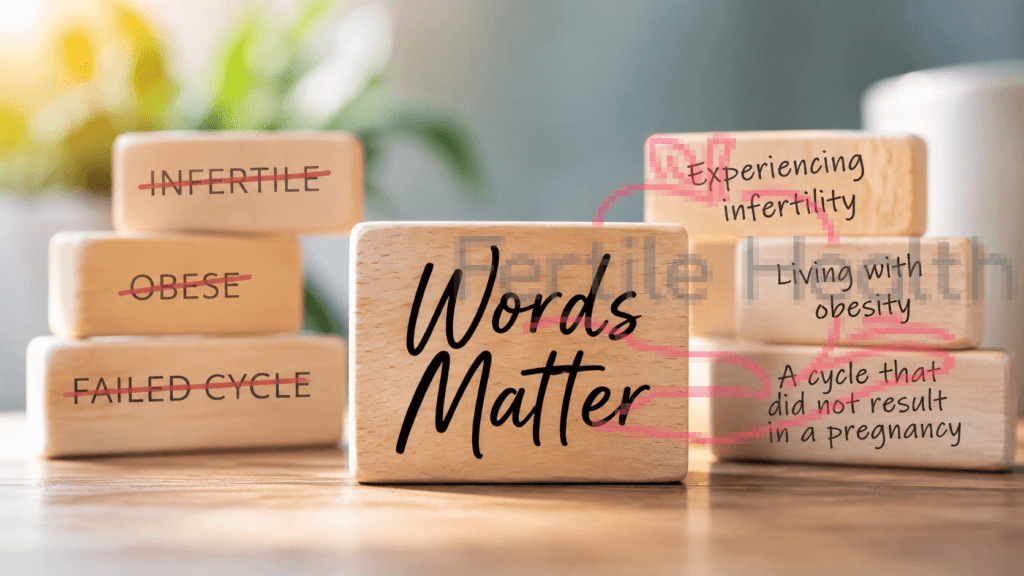
In healthcare, there’s a growing emphasis on something called people-first language. The concept is simple: when possible, we describe a person as having or experiencing a condition rather than using the condition as a label.

For example, instead of saying someone is “obese,” we might say they are “living with obesity.” Rather than describing a woman as “infertile,” we might say she is “experiencing infertility.”

Why does this matter?

Because infertility is something you may be experiencing. It is not who you are. The same is true of obesity, diabetes, PMOS (formerly PCOS), endometriosis, or any number of other conditions that may affect reproductive health.

These diagnoses may influence your health, your treatment options, and sometimes even your day-to-day decisions. But they don’t encompass the entirety of who you are.

You are still a partner, friend, daughter, sister, professional, athlete, artist, or whatever else makes you uniquely you.

Your diagnosis is part of your medical history. It is not your identity.

When Medical Language Becomes Personal

Fertility treatment introduces patients to an entirely new vocabulary, and not all of it feels particularly kind.

Poor ovarian responder. Failed cycle. Failed implantation. Incompetent cervix. Advanced maternal age. Abnormal embryos.

These terms may have specific clinical meanings, but when you’re the person hearing them, they can feel remarkably personal.

Consider the phrase “failed IVF cycle.”

It’s commonly used in reproductive medicine, and most of us understand what it means. But for someone who has invested time, money, physical effort, and emotional energy into treatment, hearing the word failure can carry an additional message—even when none was intended.

I failed. My body failed. I couldn’t do what I was supposed to do.

But you didn’t fail.

The treatment did not result in the outcome everyone was hoping for. That’s an important distinction.

Similarly, being described as a “poor responder” refers to how the ovaries respond to stimulation medication. It is not a reflection of how well you tried, whether you followed instructions, or anything you did or didn’t do.

Sometimes simply reframing the terminology can create a little distance between the medical event and the person experiencing it.

Instead of “I failed IVF,” perhaps:

“My IVF cycle did not result in a pregnancy.”

Instead of “I’m infertile”:

“I’m experiencing infertility.”

Instead of “My body isn’t working”:

“My body is facing a reproductive health challenge.”

These alternatives don’t minimize the disappointment or make a difficult situation disappear. They simply remove the implication that the diagnosis or outcome is a personal shortcoming.

The Weight of Words

Language surrounding weight deserves particular attention, especially because weight and metabolic health often become part of fertility discussions.

For people living with obesity, medical appointments can sometimes feel as though every concern eventually comes back to weight.

The Obesity Action Coalition encourages the use of people-first language, such as “person living with obesity” rather than “obese person,” to help reduce the tendency to define individuals by body size.

This isn’t about avoiding important medical conversations. Weight and metabolic health can be relevant to reproductive health, and patients deserve accurate, evidence-based information.

It’s about how those conversations happen.

There’s a difference between:

“You need to lose weight before treatment.”

And:

“Would it be okay if we talked about how metabolic health may affect your treatment options and what support might be helpful?”

Both may lead to a discussion about weight, but the second invites collaboration rather than making assumptions about the person.

Patients deserve to understand their health without feeling that their body is being judged.

The Labels We Give Ourselves

While healthcare professionals have a responsibility to communicate thoughtfully, it’s also worth paying attention to the language we use in our own internal conversations.

Think about how often a disappointing outcome becomes a statement about who we are.

“I’m a failure.”

“My body is broken.”

“I can’t do anything right.”

“I’m never going to get pregnant.”

When we’re overwhelmed, these thoughts can feel like facts rather than interpretations of a difficult experience.

One strategy borrowed from Acceptance and Commitment Therapy (ACT) is to create a little distance between ourselves and our thoughts. Rather than trying to force positive thinking or convince ourselves that everything will work out, we can simply recognize a thought for what it is.

For example, instead of saying:

“My body has failed me.”

Try:

“I’m having the thought that my body has failed me.”

It may sound like an insignificant change, but adding those few words can help us recognize that a thought, however powerful, is not necessarily a fact.

You can acknowledge that you’re disappointed, angry, exhausted, or frightened without allowing those feelings to become a permanent description of yourself.

And you don’t have to love your body every day to recognize that it deserves compassion.

It’s Okay to Ask for Different Language

If a term your healthcare provider uses makes you uncomfortable, it’s perfectly reasonable to say something.

You might ask:

“Could you explain what that means without using the word failure?”

Or:

“I understand that poor responder is a medical term, but could we describe it differently?”

You can also ask for clarification when terminology feels judgmental or confusing.

The goal isn’t to eliminate medical terminology. Accurate communication is essential, and some clinical terms have established meanings that are important for treatment decisions.

The goal is to create a conversation in which you feel like a participant in your care rather than a collection of diagnoses, laboratory results, and treatment outcomes.

It’s also worth remembering that people have different language preferences. Some individuals are comfortable identifying themselves by a diagnosis or characteristic, while others prefer people-first terminology. Neither preference needs to be imposed on everyone.

What matters is having the opportunity to be heard.

A Small Change Worth Practicing

The next time you find yourself describing your fertility journey, your body, or a medical condition, pay attention to the words you choose.

Ask yourself:

Am I describing something I’m experiencing, or am I allowing it to define who I am?

You don’t have to monitor every word or correct every negative thought. And you certainly don’t need another thing to feel you’re doing incorrectly while navigating fertility treatment.

But perhaps you can begin by offering yourself the same kindness you would extend to someone you love.

If a friend told you that her IVF cycle hadn’t resulted in a pregnancy, would you tell her she failed?

Probably not.

You would recognize that she experienced a disappointing outcome, that she may be hurting, and that she deserves compassion.

You deserve that same consideration.

Your diagnosis describes something about your health. It does not define your worth, your identity, or the person you are beyond it.

And sometimes, changing the way we speak about ourselves is a small but meaningful place to begin.
When Your Brain Becomes a Fertility Expert

If you have ever gone through infertility treatment, you know that your brain can become a very noisy roommate.

Not the quiet, respectful roommate who occasionally asks if you need anything from the grocery store. More like the roommate who follows you from room to room offering unsolicited commentary about your follicles, embryo grades, age, AMH, uterine lining, other people’s pregnancies, and whether that cramp or breast tenderness you just felt four days after your embryo transfer means something.

Although well-meaning, your brain is misguided. It prepares you for what it perceives as “danger” at all times to protect you, but this results in a constant state of stress and unrest. Because infertility involves so much uncertainty, your brain often decides that its job is to fill in the blanks. Unfortunately, it rarely fills them in with something like, “You know what? We really don’t have enough information yet. Let’s make some tea and watch Netflix.”

Instead, it tends to go directly to:

“This cycle isn’t going to work.”

“My eggs are terrible.”

“My body is failing me.”

“Everyone else gets pregnant except me.”

“I waited too long.”

“If this embryo doesn’t implant, I’m never going to be a parent.”

And my personal favorite category: interpreting every physical sensation during the two-week wait.

Cramp? Implantation.

No cramp? Definitely didn’t implant.

Breasts hurt? Pregnant.

Breasts don’t hurt? Not pregnant.

Tired? Pregnant.

Not tired? Obviously doomed.

Your brain can turn a perfectly ordinary trip to the bathroom into a forensic investigation.

The problem isn’t that these thoughts show up. Of course they do. You are a deeply feeling human being going through something uncertain, expensive, invasive, emotional, and largely outside of your control. The problem is that when your brain says something, you automatically assume it is true.

Meet Your Fertility-Brain

There is a concept from Acceptance and Commitment Therapy (ACT) called cognitive defusion. This sounds very clinical and sophisticated, but it really isn’t. Cognitive defusion essentially means learning to notice your thoughts without automatically believing everything they say.

Think about how easily this happens.

You don’t usually say:

“My brain has generated a hypothesis that this IVF cycle may be unsuccessful.”

You say:

“This isn’t going to work.”

And suddenly a thought has become a fact.

Your brain has gone from commentator to CEO without anyone approving the promotion. Cognitive defusion is the process of gently demoting it. Your brain can still attend the meetings. It can submit suggestions. It can even send strongly worded emails.

It just doesn’t get to make every decision.

Try adding five little words

One of the simplest ways to practice cognitive defusion is to add:

“I’m having the thought that…”

So instead of:

“This cycle is going to fail.”

Try:

“I’m having the thought that this cycle is going to fail.”

Instead of:

“My body has failed me.”

Try:

“I’m noticing that I’m having the thought that my body has failed me.”

Instead of:

“I’ll never be a mother.”

Try:

“I’m having the thought that I’ll never be a mother.”

Read those sentences again.

The scary thought didn’t disappear.

You didn’t replace it with:

“Everything is amazing! My embryo is definitely implanting!”

Because you don’t know that either.

You simply put a little space between you and the thought.

And that tiny space matters.

It reminds you that your brain is producing a thought because you are scared, disappointed, hopeful, exhausted or some complicated combination of all four.

The thought is real, but that doesn’t mean the thought is true.

Please don’t add “thinking positively” to your fertility to-do list

I think this distinction is particularly important during infertility treatment because patients are constantly told to “stay positive.”

As if you don’t already have enough to do.

Take your medications.

Get your blood drawn.

Schedule your ultrasound.

Call insurance.

Order more medication.

Don’t forget to take your trigger shot at a certain time.

Drink a lot of water.

Eat protein.

Try acupuncture.

Reduce stress (yeah, right).

And, apparently, maintain an unwavering belief that everything will work out beautifully.

No pressure.

There is nothing wrong with positive thinking when it genuinely helps you. But ACT doesn’t require you to replace scary thoughts with happy ones.

You don’t have to convince yourself that your transfer will work.

You don’t have to visualize two pink lines.

And you certainly don’t have to worry that having negative thoughts will somehow cause your treatment to fail.

Sometimes the most psychologically flexible response is simply:

“I really want this to work, and I’m scared that it won’t.”

Both things can be true.

Your brain is trying to protect you

Here is another thing that helps me understand anxious thoughts: your brain is not necessarily trying to torture you.

It is often trying to protect you.

If you’ve experienced a failed cycle, miscarriage, disappointing fertilization report, or negative pregnancy test, your brain remembers.

So the next time you approach something hopeful, it may whisper:

“Don’t get excited.”

“Remember what happened last time.”

“Prepare yourself.”

“This probably won’t work either.”

Your brain believes that if it predicts the disappointment first, maybe the disappointment will hurt less.

But anticipating pain doesn’t necessarily prevent pain. Sometimes it just makes us experience it twice as your brain can’t tell the difference between the actual event and just thinking about the event.

You don’t need to argue with your brain.

You can simply notice what it’s doing.

“Oh. There’s my brain trying to protect me again.”

And then return to what is actually happening right now.

What do I actually know right now?

This is one of my favorite questions.

During fertility treatment, there is often an enormous gap between what we know and what our brain is predicting.

What do I know?

“My embryo transfer was four days ago.”

What is my brain predicting?

“It didn’t work because I don’t feel anything.”

What do I know?

“I have three embryos being biopsied.”

What is my brain predicting?

“They will all be abnormal.”

What do I know?

“My friend just announced her pregnancy.”

What is my brain telling me?

“Everyone gets to have a baby except me.”

That doesn’t mean you have to dismiss your fear.

It means you can recognize the difference between information and imagination.

Your brain is remarkably talented at both.

And then comes the most important question

Once you’ve noticed the thought, ask yourself:

“What do I want to do next?”

Not:

“How do I make this anxiety disappear?”

Not:

“How do I stop thinking about infertility?”

Not even:

“How do I convince myself everything will be okay?”

Just:

“What would help me be the person I want to be for the next hour?”

Maybe you go for a walk.

Maybe you finish your work.

Maybe you call your friend.

Maybe you cry in the shower.

Maybe you put your phone down because you have officially exceeded your daily allotment of fertility-related Google searches.

Maybe you eat dinner with your partner and declare infertility a prohibited topic for the next 60 minutes.

Maybe you watch something completely ridiculous on television.

Your difficult thought is allowed to come with you.

It just doesn’t have to drive.

You are still in there

Infertility has an annoying ability to feel all-consuming.

At some point you may realize that you are no longer Monica-who-is-going-through-fertility-treatment.

You have somehow become an infertility patient, a full-time position with terrible benefits.

Your calendar revolves around appointments. Your conversations revolve around treatment. Your browser history and ‘open tabs’ are horrifying. Your bathroom contains enough medication and pregnancy tests to open a small pharmacy.

And your thoughts begin revolving around the same thing.

Cognitive defusion is one small way of reclaiming some space.

You are the person noticing the thought.

You are not the thought itself.

You can feel afraid and go to dinner.

You can feel jealous and still love your pregnant friend.

You can be devastated by a failed cycle and laugh at something stupid the next day.

You can desperately want a baby and still enjoy the life you have right now.

None of those things cancel each other out.

As I wrote before about letting our emotional “hair” down, we don’t need to spend all of our energy trying to tame every uncomfortable feeling before we continue living our lives.

The same is true of our thoughts.

Let them be messy.

Let them show up.

Notice the particularly loud and persistent ones.

And when your fertility-brain starts following you around the house, predicting your future, analyzing your symptoms, and generally behaving like an unpaid reproductive endocrinologist, you can acknowledge it.

“Thanks, brain. I know you’re trying to help, but I’ll take it from here.”

Warmly,

Monica

Kind and Brave

To My Daughters,

I remember a car ride years ago when one of your brothers was upset that he got a bad grade and was worried that he wasn’t ‘smart’. I told all of you that the most important qualities in a person (to me) are being kind and brave. You all got the gist of being kind but had some trouble envisioning what being brave looked like at your age. Your then-5 y/o-brother asked if it meant that he should act like a superhero and save the world from villains, but we discussed that it’s actually simpler than that. You can be brave on a regular basis in small (but impactful) ways like standing up for a kid who is being made fun of, or staying firm in establishing boundaries, even when others don’t like them. Bravery is having integrity (often quietly but sometimes fiercely) in situations, even when it feels hard or when others don’t.

As you know, I am both heartbroken and infuriated by the decision of the Alabama Supreme Court in mid-February where it ruled that three couples who had frozen embryos destroyed in an accident at a storage facility could pursue wrongful death lawsuits for their “extrauterine children.” Although once Roe V Wade was overturned, we (in the infertility field) knew that this decision might negatively affect us and our patients, I naively believed that they would leave IVF alone for now, since (last I checked) trying to build your family is pro-life. To me, being ‘pro-life’ implies that you care about the life of the child at all stages, not just before he/she is born. Apparently, ‘extrauterine’ in Alabama extends to protecting embryos in an IVF lab but not the babies born from these embryos once they live in the real world. Alabama (along with many of the other restrictive states) has one of the highest rates of infant mortality and ranks as one of the lowest states in terms of the health of the children who live there. Making laws that only protect fertilized eggs (but not the babies generated from them) is not ‘pro-life’, it is pro-birth. What is even more alarming is that this decision is just the beginning of a dangerous trend nationally, as there are over a dozen states that consider ‘life’ starting at the time of fertilization.

The Supreme Court of Alabama consists of a chief justice and eight associate justices who, at the time of this writing, are all Republican. Their political affiliation shouldn’t matter as long as they remain unbiased and don’t use their positions to further their political agenda and/or personal philosophy. The issue with this decision is that it reads as theocratical. Consider the following language in the ruling: “The People of Alabama took what was spoken of the prophet Jeremiah and applied it to every unborn person in this state” and “[Alabamians] have required us to treat every human being in accordance with the fear of a holy God who made them in His image”. In fact, the lead justice not only often invokes scripture in making legal decisions, but he criticizes those who don’t and supports an organization of conservative Christians who believe that we should use fundamentalist beliefs to influence and run government.

The Bible is not (nor was it meant to be) a legal textbook, and it’s a judge’s job to be objective and rely on case law and legal precedent even if they are philosophically uncomfortable or opposed to it.

As you know, I grew up Catholic. I believe in God and I feel strongly about respecting other people’s religious and spiritual beliefs. As a Nurse Practitioner, I’ve seen many examples of patients or couples who chose to alter their suggested treatment course based on their religious beliefs. In the case of one couple who needed IVF, they asked that only a few eggs (out of the many that were produced) be fertilized as they were uncomfortable with freezing extra embryos. We counseled them that reducing the number of embryos created may reduce the odds of achieving a pregnancy that cycle (necessitating subsequent cycles at their financial and emotional expense) but then happily complied after we were confident that they understood. In one of my other jobs, we allowed rabbis to be present during IVF procedures whenever patients requested this.

In medicine, decisions and strategies are based on current, peer-reviewed, published scientific data that is analyzed and replicated so that it’s appropriate and applicable to most. We should not be basing medical care on the Old Testament.

The stimulation of multiple eggs during an IVF cycle is necessary to counter the natural attrition rate from mature egg to fertilized egg to blastocyst (the term for an embryo at implantation). Only approximately 30-50% of fertilized eggs progress to the blastocyst stage and 30-90% of blastocysts are aneuploid (an embryo that has an abnormal number of chromosomes, which is usually not consistent with life). This translates to the need to create many eggs just to be able to have 1-2 chromosomally normal blastocysts available to transfer back in the hope that one of them will implant and become a healthy pregnancy. Restricting the number of eggs that we can fertilize (and/or the ability to freeze extra embryos) based on theology forces medical professionals to abandon common sense and years of scientific data.

Ok, let’s circle back to you (and your brothers). Even though I am deeply concerned about the effects of this court decision (and others like it), there are still ways to be a superhero.

Maybe your sword is your voice or your pen which you can use to advocate for those who are disempowered to advocate for themselves.

Maybe your superpower is being respectful and considerate to all people, regardless of their appearance, politics, religion, circumstances, or how much money they make.

Maybe your cape is your suit or robe should you decide to pursue a role as a lawmaker or politician where you advocate for others and make fair and reasonable decisions based on common sense, defensible facts, case law, and empathy, not your personal religious beliefs or political views.

I know I sometimes embarrass you by being a firm (and sometimes loud) advocate for reproductive health but being kind and brave means doing the right thing. Even when it’s the hard thing.

But, to channel Glennon Doyle, “We can do hard things”.

Love,

Mom

slot gacor

toto

toto togel

link gacor

slot gacor

slot gacor

kampungbet

slot gacor

situs gacor

situs togel

slot gacor

situs toto

link slot

toto

situs gacor/a>

kampungbet

kampungbet

A Letter to My Daughters Post-Dobbs

To My Girls,

I write this letter to you as I lie in bed, one of the many nights that I have had trouble falling asleep after the Supreme Court decided to reverse Roe V Wade. I alternate between being incredibly angry and profoundly fearful for what the aftermath will mean to both of you. We are already starting to see the repercussions of it, and they are not only deeply concerning but the antithesis of all that I’ve taught you.

We have talked about physical safety and how to protect yourself, but I know that you still have a one in four chance of being a victim of sexual assault. It is unimaginable to me to think that you may not only have to deal with the consequences of the assault, but you could be forced to live with the terrible consequences of a rape-related pregnancy including depression, unstable relationships, and self-destructive behavior. One-third of women who have rape-related pregnancies do not discover they are pregnant until the second trimester, which now drastically limits (or even eliminates) their reproductive options.

As a result, I’m sorry that we will need to think twice about allowing you to apply to college in a restricted state, even if it’s a great school.

We have talked about psychological safety, healthy relationships, and boundaries, but I realize that you still have a one in four chance of being the victim of intimate partner violence, and that this violence tends to escalate when the female partner is pregnant. In fact, women with unintended pregnancies have two to three times the risk of experiencing physical violence than women with intended pregnancies. Reproductive coercion (where the male partner may forbid or punish the female partner for using contraception) is prevalent in these toxic relationships because having a child together allows the male to solidify his hold on the female, mentally, physically, and financially. In keeping with this, women who are victims of intimate partner violence have a higher rate of unintended pregnancy. It breaks my heart a little to imagine this happening to you but infuriates me to think that if it does, you don’t have options in a restricted state.

Think about this when you decide where to apply for jobs and live after college.

Perhaps most importantly, we have talked about the components of self-esteem, how it includes having a sense of agency and self-efficacy, and that your body is your own.  This is no longer true if you live in a restricted state.

Don’t be fooled by the language in the concurrence which justifies taking away your right to bodily autonomy because you can travel to another state. Extremist politicians are trying to enact laws to ban travel or to receive medication for medical abortion from another state. Justice Kavanaugh’s insistence that “Federal and state laws now ban discrimination in pregnancy and offer parental leave and insurance coverage” is laughable. This concept is better suited to the fairy tales that I used to read to you at night than the real-world experience in many places. In Mississippi, for example, there is no guaranteed paid leave, no ban on pregnancy discrimination, and the highest infant mortality rate in the country.

As a women’s health nurse practitioner, I have dedicated my entire career to working with reproductive-age women. I can tell you that the consequences of this decision are profound and far-reaching.

*Since care after a miscarriage and after an abortion are similar, a clinician may delay caring for you as he/she fears legal consequences.

*If you need to take a medication to control a chronic condition and that medication happens to be teratogenic or an abortifacient, this medication may be withheld from you simply because you are of reproductive age and might get pregnant while on it.

*If you have an ectopic pregnancy that is not yet ‘life threatening’, your care may be delayed or denied as many doctors and hospitals fear the legal loopholes and subsequent repercussions embedded in the intentionally murky language of many state laws.  Waiting an hour or two can be disastrous, in the context of a ruptured ectopic pregnancy, as every minute counts.

*If your membranes rupture in the second trimester, but there is still a fetal heartbeat, you may have to continue to carry the pregnancy at risk of infection, which could affect your current health or future pregnancies, even though there is no chance that the fetus can survive.

The list goes on and on.

I’m sorry that your chance to have future children, your integrity, and your mental health can be sacrificed for potential life.

I worked in Labor and Delivery and was there to support families who had babies with catastrophic and/or lethal congenital anomalies. The families who delivered these babies (who died at birth or soon after, often with profound, visible abnormalities) were devastated. Many of the mothers, whom I kept in touch with afterwards, shared that they needed years of therapy and/or grief counseling as a result of that experience. One woman (whose baby had anencephaly) told me that the day she delivered felt like ‘a terrible movie that she couldn’t stop playing’ in her head. If a congenital anomaly like this is found during one of your pregnancies, and you choose to continue the pregnancy, I will be there with you to hold your hand and get you through the weeks, months, and years to come. If you decide to terminate, I will support your decision as I’ve seen first-hand the effects of this on families.

I just want you to have that choice.

Dad and I laugh at the story of how I became pregnant with your brother without realizing it for a few weeks as I was still breastfeeding. Dad’s joke is “How did you not know you were pregnant? Don’t you do this for a living?” We can laugh about it because we were in a loving relationship with the financial means and support needed to have kids so close together in age.

Many aren’t so lucky.

Close interpregnancy intervals (like mine) are a common reason for late recognition of pregnancy. Many women (like me) didn’t have a true menstrual cycle while nursing, and don’t realize they are pregnant until either symptomatic or showing. Had I been in an abusive relationship or not financially able to support so many kids at once, instead of a funny story, it would have become a cautionary tale. In a restricted state, it may have been too late for me to make a reproductive choice by the time I realized I was pregnant. I may not have been able to go back to work as my childcare costs would have exceeded my salary. I may have had postpartum depression after having had you, and the thought of another pregnancy would have made me feel mentally unfit to take care of you and your siblings. Although your brother is a treasure to me (and I can’t imagine our lives without him) I wasn’t a better person for having proceeded with the pregnancy, I was just lucky to have been in a situation where I was able to do so.

I will end with the fact that I also spoke to your brothers about the effect that this decision will have on all of us. One of them said to me “Well, mom, I hear you, but how are you going to change a bunch of middle-aged men’s minds?” My reply is, “I’m not starting with them, I’m starting with you.” If I can teach my sons empathy, to truly understand what it would feel like if their bodily autonomy and choices were taken away, then that is where I will start. If I can emphasize accountability, that it takes two people to generate a pregnancy then, maybe one day, one of my sons (or their friends) will grow up to shape laws that don’t marginalize women.

I could have never imagined that my children would have less reproductive choices than me and that my daughters would be treated like second-class citizens, but I promise you that my colleagues and I will relentlessly fight to restore your rights.

I hope and pray that, should you need it, you are in a state where your healthcare provider is permitted to prioritize you- the living, breathing person who is there in front of them, over any potential person, political agenda, or religious ideal.

Love,

Mom

slot gacor

toto

toto togel

link gacor

slot gacor

slot gacor

kampungbet

slot gacor

situs gacor

situs togel

slot gacor

situs toto

link slot

toto

situs gacor/a>

kampungbet

kampungbet

When will we stop Blaming Women for their Infertility?

In 1997, when I first started working in the field of reproductive endocrinology and infertility (REI), there was a stigma attached to infertility, as if the women being treated for it were defective because pregnancy didn’t come easily or unassisted. Fortunately, over the last twenty-plus years, this perception has changed, and women are less embarrassed or ashamed to admit to being diagnosed with infertility. This shift is somewhat due to these women sharing their stories both publicly and privately, and increasing the awareness of the prevalence of infertility, its causes, and treatments.

Consequently, I was excited to see the publication of a recent article in the NY Times about female physicians relating their experiences with infertility. The authors represent a growing demographic within REI: women who delay family-building to pursue a career.  Unequivocally, the road to being a physician is rigorous (some would say arduous) and long: four years of college, four years of med school, and another few years of residency (and longer if you pursue fellowship). Half of all medical students are now women, and training to be a physician can occupy their peak reproductive years. (Most agree that fertility potential starts to decline when a woman is in her mid-30’s). This article underscored the importance that women who plan to become physicians (or lawyers or women who delay childbearing for any other reason) become aware of their fertility potential, options, and the procedures that are available to them.

The article was impactful, as evidenced by responses on social media.  Many were grateful that the authors gave a voice to the emotional impact of infertility. Some responded that they didn’t realize how quickly the clock ticks, in terms of fertility, and are now considering making an appointment with a specialist to review their options. Then, there was another subset of responders (largely men) whose derogatory and unenlightened comments illustrate a false, yet pervasive, narrative that women are to blame for their infertility.

“I suspect the stresses of being in that profession are much to be blamed.”-Marty G.

“Get married young and have support through graduate school.”-Nathan M.

“Older women are less fertile than younger. I’m really hoping they know this though?”-Stanley S.

“Can’t have everything, I guess.”-Tom H.

“Squanders most fertile years to pursue a career, then is surprised that their fertility went down.”-Jake W.

As if this wasn’t bad enough, faulting women who have infertility is not limited to strangers. Many of my patients have also been criticized by well-meaning relatives, friends, and co-workers who offer unhelpful advice such as:

“Just relax, you’re too stressed. Go on a vacation and it will happen. My friend’s daughter’s roommate did this and it worked” or “You are too fat to get pregnant. Lose some weight and see what happens” or “Maybe it’s a sign from God that you are too old to get pregnant.”

I don’t feel that it is worth anyone’s time debunking each of these comments, but I would like to stress the following:

Stress is never to blame for infertility. Full stop.

A woman is never to blame for her infertility. Full stop.

People make difficult decisions with the information that they have at the time. To criticize them for their choice is simply mean and short-sighted.

Finally, to the men whose responses I listed above, I would like to refer you to a quote by Brene Brown: “If you are not in the arena getting your ass kicked, I’m not interested in your feedback.”

slot gacor

toto

toto togel

link gacor

slot gacor

slot gacor

kampungbet

slot gacor

situs gacor

situs togel

slot gacor

situs toto

link slot

toto

situs gacor/a>

kampungbet

kampungbet

toto togel toto togel situs gacor situs togel toto togel toto togel toto togel link gacor toto togel link gacor togel online slot gacor link gacor situs gacor toto togel kampungbet toto togel link gacor toto togel situs togel situs togel toto togel link gacor slot gacor slot gacor situs togel togel online kampungbet situs gacor toto togel slot gacor link gacor situs hk situs hk situs toto slot gacor link gacor situs toto situs togel toto link gacor slot gacor link gacor situs gacor toto togel situs toto toto togel toto togel toto togel toto togel toto togel kampungbet kampungbet kampungbet situs gacor situs gacor toto togel kampungbet kampungbet situs gacor kampungbet kampungbet kampungbet kampungbet kampungbet kampungbet kampungbet kampungbet kampungbet kampungbet kampungbet kampungbet kampungbet kampungbet

Lessons I Learned on a Bus

Image courtesy of Adobe Stock

I am a nurse practitioner and a health coach who specializes in helping pregnant, or soon-to-be pregnant, women achieve their health goals. Many of my clients have bigger bodies and I, technically, am ‘standard’ weight, according to the very flawed BMI chart. As a result, I am frequently asked or emailed a version of the question below, as people wonder why, if I don’t have personal experience with obesity, am I so passionate about advocating for those who do. As is often the case, growth follows discomfort, and, for me, a painful event in childhood equipped me with the tools I needed to advocate for people of all shapes and sizes.


Dear Monica,

I love your blog posts and your “Ask Monica” series. You state that you’re an advocate for people in bigger bodies. Were you ever fat and, if so, how did you lose the weight? If not, why do you feel so strongly about this topic?

Thanks,

Dana


Dear Dana,

I started my career as an Infertility Nurse Practitioner but realized that I ideally wanted to spend more time talking to my patients about their physical, metabolic, and emotional health, and not just the medical aspects of fertility. So, I became a health coach and, as such, I have developed deep relationships with my clients (many of whom are women in bigger bodies) who share with me their personal narratives of shame and humiliation due to their weight.

Almost every single one of them has told me how important it is to have an advocate, someone to stand up to the fat-shaming that they often encounter.

Although I have not been mocked for my weight, I have been derided due to my appearance. It happened in seventh grade, when I was bullied on my school bus. The remarks and taunts were daily and relentless. My not-yet-diagnosed polycystic ovarian syndrome (PCOS) was raging, and every day it seemed I had a new pimple on my face or grew a dozen new body hairs. I am Italian-American, so there was no shortage of body hair anyway, but suddenly it seemed that my hair growth was supercharged and incredibly obvious.  

My appearance did not go unnoticed by a girl on my bus (whom we will call) Tricia. She called me names like Fuzzy Muzzi (Muzzi is my maiden name) and gleefully and mercilessly taunted me on the way to and from school.  She warned me that I would never have a boyfriend ‘looking like I do’ and that the girls I thought were my friends were just pretending because they felt sorry for me.

It seemed that she spent her time and energy finding new words for ‘ugly’, and I spent mine trying not to cry.

Of course, I told my parents, whose advice was to ignore her (although my mom used this inopportune time to give me an eyebrow-plucking tutorial). I begged them to drive me to school, but neither of them had jobs that allowed this.

I begged the driver to let me change my seat, but all seventh graders sat in the same section.

So, I had to deal with Tricia, her taunts, and the interminable bus ridesfor the remainder of the school year. I don’t even remember how long it lasted or how it ended (I think she found someone else to harass) but here is what I do remember: hot shame, embarrassment, and the confirmation of what I already knew: I was unattractive, gross, and unacceptable.  

I had friends who rode that bus, but they didn’t defend me for fear that they would become her next target. Some of them didn’t even want to sit with me for the same reason. Although I now understand this, I felt isolated and alone. The situation seemed unbearable.

I remember feeling helpless and anxious as I walked up the stairs of that bus day after day, like I was entering a firing squad without armor. It took me a long time (and hours of laser hair removal) to believe in my self-worth again, and I am still triggered by certain situations that remind me of being the target of a bully. Even as I write this, thirty-plus years later, I recognize the tight knot of anxiety and shame in my chest and feel my eyes burning as I visualize myself at that age.

I wish I could go back and hug the seventh-grade me and assure her everything will work out.

So, to answer Dana’s question, no I was never *fat but I was a target, due to my looks. I felt angry, sad, and helpless at being ridiculed for something beyond my control, which I can imagine is not dissimilar to my clients’ personal experiences with being the victim of weight bias.

The science behind bodyweight (and weight loss) is clear. Our bodies have an evolutionary adaptation to avoid (what is perceived as) famine. Once weight is gained, the body employs many metabolic adaptations to keep it there, and the higher weight becomes the body’s new set point. Gaining excess weight is easy. Many who fall in the ‘obesity’ categories on the BMI chart have a strong genetic tendency to gain excess weight, quite possibly as strong as a tall person’s predisposition to being tall. This genetic disposition combined with an environment where ultra-processed food is plentiful and cheap, and the common habit of emotional eating, create the perfect cocktail for excess weight. Diets don’t work and exercise is great for mental benefits, but as recent data shows that when someone in bigger body exercises, their brain conserves energy in other ways to maintain their current weight.  

Consequently, I always stress that people with obesity have bigger bodies not because of what they do, but despite what they do.

Women in bigger bodies live in a world that is full of people like Tricia. The fat-shaming that they experience is constant and relentless and certainly doesn’t help them lose weight. It has the opposite effect. Studies show that being the recipient of weight bias contributes to weight gain and weight cycling, two factors that contribute to obesity.

I now see Tricia as my teacher and the situation on the bus as my classroom. The author Glennon Doyle writes: “Pain is not a hot potato to pass on to the next person or generation. Pain is not a mistake to fix. Pain is just a sign that a lesson is coming. Discomfort is purposeful: it is there to teach you what you need to know so you can become who you were meant to be. Pain is just a traveling professor.”

I use the helplessness that I felt then as motivation to be the person that I wished I had in seventh grade. I empower and advocate for my coaching clients by providing information and support and, in doing so, help them reclaim any dignity that they may have lost by being the recipient of discrimination and cruelty. Most importantly I try to make a dent in a deeply-flawed health care system where we are trained to manage the consequences of excess weight, but not informed about the factors that lead to it.

Those of us who care for people with obesity need to understand the complexities and nuances of excess weight and our body’s determination to hold onto it. Most health care providers are well-meaning but, like me and all the nurses and doctors that I know, not formally trained on the science or behavioral aspects of excess weight and how to combat it.

As a health coach, my job isn’t to help women to become thin. My job is to help women become the best version of themselves, whatever that looks like.

By the way, I did find Tricia on social media recently and sent her a message thanking her for making me who I am today. I didn’t receive a response but then, none is needed.

*Author’s Note: I am following Dana’s lead and using the word ‘fat’ as a neutral, descriptive word, not as a pejorative term.

slot gacor

toto

toto togel

link gacor

slot gacor

slot gacor

kampungbet

slot gacor

situs gacor

situs togel

slot gacor

situs toto

link slot

toto

situs gacor/a>

kampungbet

kampungbet

toto togel toto togel situs gacor situs togel toto togel toto togel toto togel link gacor toto togel link gacor togel online slot gacor link gacor situs gacor toto togel kampungbet toto togel link gacor toto togel situs togel situs togel toto togel link gacor slot gacor slot gacor situs togel togel online kampungbet situs gacor toto togel slot gacor link gacor situs hk situs hk situs toto slot gacor link gacor situs toto situs togel toto link gacor slot gacor link gacor situs gacor toto togel situs toto toto togel toto togel toto togel toto togel toto togel kampungbet kampungbet kampungbet situs gacor situs gacor toto togel kampungbet kampungbet situs gacor kampungbet kampungbet kampungbet kampungbet kampungbet kampungbet kampungbet kampungbet kampungbet kampungbet kampungbet kampungbet kampungbet kampungbet

Dear Fertility Nurse: Scrabbled

“I am really having trouble being happy for my friends and family who seem to be getting pregnant easily. I’ve cut off communication with some of them, stopped going to baby showers, and I feel like a jerk. How do I manage this?”-Heidi R.

Dear Heidi,

Growing up, I played a lot of boardgames, one of my favorites was Scrabble. Scrabble is a game where everyone gets tiles that are letters and you compete against 1 to 3 other people to use your letters to form words on the board. You are trying to get the most points and get rid of your tiles.

Playing hundreds of rounds of Scrabble taught me two things about myself that still hold true today: I love words and I hate to lose.

Most of the time, I would play with my immediate family or my sister’s friends and we would look for ‘tells’: signs that someone was about to unleash a word that would generate a bunch of points. If you are not familiar with Scrabble, the rarer the letter, the more points you could get, so an Z or a Q were each worth 10 points due to the degree of difficulty finding a word in which you can use them.

One time, I was riding high on an amazing (I thought) word that really pushed me past most players and tied me with my sister who was not only 7 years older, but a walking dictionary. As we were going around the table for one of the final laps, I see a change in my sister, a tell. Hers is an almost imperceptible smile, a look that I interpreted as smug and self-satisfied, and I knew it could only mean one thing: She is using her J. You see the J is the holy grail of Scrabble, in my opinion. It’s worth a whopping 8 points but you can actually use it in a decent number of words (unlike Z) and you don’t need to also have a U (unlike Q). The J is a game-changer and I knew then and there that my sister had won. I felt angry and resentful.

It felt like an unfair fight.

My sister and her friends knew more words anyway and were very clever. I needed a plan to level the playing field.

So, next time I offered to set up the game. I made sure that no one was around, then I pocketed two of the J’s. Not all of them, because that would be obvious, just two that I later could imperceptibly add to my stash of letters until I used mine or someone else’s letters to build the perfect J word. This worked for a while. I was often the winner if my sister wasn’t playing, and pretty even with her if she was, and it felt great. I felt redeemed.

Until one day, I was putting the game away and heard someone crying. I took a quick peek and saw that it was my closest friend. She had come in last that day. In fact, since she was the youngest she often came in last, but today she was burdened by a bunch of Q’s with no U’s and just shitty luck and I guess it felt like too much. My feeling of elation quickly soured and I realized that I had to confess. I told her about the J’s. She was both horrified and impressed. Then she said to me “Why are we even playing this game, Moni? It’s making us both so sad and frustrated.”

I strongly believe that it is a worthwhile skill to accept your feelings (even so-called negative ones) as valid and necessary in order to live a vibrant life.

You see, Heidi, your pregnant friends were lucky enough to have all of the good tiles. And it sucks because you try your best and persevere through your treatments and deep down you’re happy for them, but it feels like every time you turn over a tile, it’s another Q (without the U) or Z. Now you’re in a quandary because this bad luck is starting to really get to you and making you avoid events and conversations with people that you love which makes you feel disconnected from the person that you want to be in life.

My first question to you is do you want to ‘play the game?’ That is, do you even like going to baby showers or is this something that you feel that you need to do? I didn’t like going to baby showers. I had so many cousins and went to so many baby showers by the time that I was old enough to have a baby that I was ‘baby-showered-out’. So I reserved my right to say no to some people and only attend the baby showers of my closest friends and family members. This is one option for you. You may decide to conserve your mental energy to only attend the baby showers of your super-close friends, ones for whom the risk of missing their shower feels worse than going to it and possibly feeling sad for a while after. You can expect that you will probably feel sad or some other yucky emotion afterwards, but I strongly believe that it is a worthwhile skill to accept your feelings (even so-called negative ones) as valid and necessary in order to live a vibrant life, and allow yourself to feel them (I will be writing about how to do this on a future post).  

During your fertility journey, maybe if you can’t find fair, you can find meaning.

Remember when I said that playing Scrabble against older kids didn’t feel like a fair fight? During your fertility journey, maybe if you can’t find fair, you can find meaning. For many of my clients, it is the perfect time to cultivate an important life skill: setting and maintaining boundaries.

A boundary is for your benefit and defines what you will and will not do. For example, for many, scrolling your social media feed may feel like a land mine. You want to catch up on other people’s lives, but you have to carefully sidestep the endless parade of hot button issues for you. These can include your cousin who posts strong political views or a high school classmate posting pictures of maimed animals or your friend who keeps complaining that she “just looks at her husband and gets pregnant”. May I suggest that you “Marie Kondo” your social feed and pause, mute or unfollow those feeds that don’t bring you joy. Even if you like the people posting them. Getting bombarded by pictures of injured wildlife or pregnant bellies when you are struggling can make anyone feel like crap. They have the right to post them and you have the right to shield yourself from them.

“…those who are mad that you enforced a boundary probably benefited from you having none.“

You may have to tell your close friends and relatives that you don’t want to talk about your family planning every phone call or family event. This should be done in advance via phone call or conversation and can sound something like: “Aunt Cathy, I’m excited to get together for Thanksgiving, but I no longer want to discuss when I’m going to have a baby.” Be both firm and fair and if someone doesn’t respect your boundary, then be prepared to enforce a consequence (i.e. you won’t go to Aunt Cathy’s for the holidays). I read once that “those who are mad that you enforced a boundary probably benefited from you having none.”

Setting boundaries can be difficult, but they are a huge component of self-care and one of the most important actions that you can take during your fertility journey to protect your mental health. There are many resources about how to set boundaries (one of my favorite is @the.holistic.psychologist on Instagram and DrCloud.com) and one of the best ways to practice these is to role-play with a trusted friend or family member. I’m not kidding. I do this with all of my clients and actually give them scripts before we practice (we call it ‘striking while the iron is cool’) so that when the time comes to actually enforce one, it feels intuitive.

Finally, Heidi, I hope you use my story as a cautionary tale. Consider and decide (on a case-by-case basis) if you want to engage in a situation or setting that tests your resilience.  If you do, don’t steal the J’s, like I did. Proceed with caution, but integrity, and expect to have an emotional hangover after. If you decide to pass, realize that this was the best decision for you at the time.

You don’t need to play the game.

Scrappy not scrabbled,

MM

slot gacor

toto

toto togel

link gacor

slot gacor

slot gacor

kampungbet

slot gacor

situs gacor

situs togel

slot gacor

situs toto

link slot

toto

situs gacor/a>

kampungbet

kampungbet

toto togel toto togel situs gacor situs togel toto togel toto togel toto togel link gacor toto togel link gacor togel online slot gacor link gacor situs gacor toto togel kampungbet toto togel link gacor toto togel situs togel situs togel toto togel link gacor slot gacor slot gacor situs togel togel online kampungbet situs gacor toto togel slot gacor link gacor situs hk situs hk situs toto slot gacor link gacor situs toto situs togel toto link gacor slot gacor link gacor situs gacor toto togel situs toto toto togel toto togel toto togel toto togel toto togel kampungbet kampungbet kampungbet situs gacor situs gacor toto togel kampungbet kampungbet situs gacor kampungbet kampungbet kampungbet kampungbet kampungbet kampungbet kampungbet kampungbet kampungbet kampungbet kampungbet kampungbet kampungbet kampungbet

Letting your hair down

Hello Readers. I decided to start an (irreverent) advice column to answer the many questions that I get on a regular basis. Here is my first attempt.

“What do I do with the negative emotions that I’m experiencing during my infertility journey? I feel like I lose it all of the time, spending my days getting upset, reactive or angry.” —Claire G.

Dear Claire,

I have curly hair. This is both a blessing and the bane of my existence, depending on the day and my mood. If you have curly hair, you know that it can get very big and unruly and hard to hide. I have spent the decade of my 20’s trying various methods of taming it: braids, hiding it under hats, blowing it dry section by section. I have paid inordinate amounts of money on hairstyles that supposedly emphasize my natural curls and have come out of the salon thinking I looked pretty good. That is, until I notice a very similar-looking style on a dog leaving the pet grooming salon. I still spend a silly amount of time brushing it into the perfect ponytail that I see well-groomed, not-sweaty people wear on Instagram, only to go outside in the humidity and realize that the short hairs on my forehead have curled up in less than 5 minutes.

I have a drawer full of products to tame my hair or make it look like someone else’s. These work, sometimes for 5 minutes (if the weather is particularly bad that day) or for a whole day (this is bliss, but only happens one month out of the year or if I stay inside a climate-controlled room where only a few people get to see my hair masterpiece anyway).

So, I gave up trying to manage or tame my hair. Some days, when I really can’t deal with it, using a product or shoving it under a hat is best for me. Most days, though, I allow it to be in its natural state while I continue with my day. In time, I realized that having curly hair is part of me, but it doesn’t capture the essence of me, it’s just something sitting on my head. I can’t let it distract or deter me from going toward my personal or professional goals. My job often involves people seeing me, either via Zoom or giving presentations or teaching in front of a group. Showing up looking like a freshly-groomed poodle is distracting to all of us, at first, but in time we all just ignore my hair and listen to what I have to say.

Why am I telling you this? Because my curly hair represents your big emotions: fear, shame, anger, sadness. Like my curls, these emotions don’t capture the essence of you, they are just words and thoughts that are sitting in your head. Maybe your ‘braid’ consists of tightly-woven emotions, thoughts and feelings that you want to suppress, but then the tightness starts to cause headaches, so you unravel the braid and now you have messy hair and a headache. Maybe your ‘hat’ is the mask that you wear when you want to pretend that you are ok with the helplessness and frustration that often is generated by an infertility cycle.

You probably have a drawer of ‘products’ too because, well, some days you just want a quick way to feel good. Your drawer might contain junk food or wine or Netflix or mindlessly scrolling social media. These ‘products’ make you feel good for 5 minutes or a full day. But they don’t change the fact that you have curly hair.

You need to let your hair down while going through your journey. By this, I mean that you need to realize that you are a deeply-feeling person in a messy and challenging situation. Your feelings aren’t ‘good’ or ‘bad’. They are just part of you. Trying to suppress them is both futile and exhausting, so let them be and use your time and energy on what you need to do to be your best self that day or to accomplish your goals. Like the curly tendrils that escape from my ponytail, you might notice a particularly annoying or persistent emotion, at times, that is trying to get your attention. Notice it. Acknowledge it. Slap some hair gel on it or bobby-pin it if you need to in order to get through your day and realize that that was the best action or strategy for you at the time. Similarly, don’t base your day or self-worth on the fact that you felt angry and acted on it.   

Most of us think that our big emotions can hurt, harm or kill us unless we do something about them, but this isn’t true. In fact, our brain processes emotions very quickly (in about 90 seconds) when we don’t attach or tether them to a story or allow them to play on an endless loop in our heads. It might seem counterintuitive, but let them be. If particularly painful, sit with them, notice what they feel like in your body and how it feels to let them go. Allow them to co-exist with the behaviors and actions that help you feel productive or powerful. It might surprise you to know that there is room for everyone.

So now you know my secret: every time you see me with straight, beautiful hair, just know that the curls are lurking, just waiting to come out. If you see me with crazy, curly hair, then that day I clearly didn’t care to spend the time taming it. But guess what? I can be the best damn me regardless of hair or humidity and you can too.  

Warmly and Wildly,

Monica

slot gacor

toto

toto togel

link gacor

slot gacor

slot gacor

kampungbet

slot gacor

situs gacor

situs togel

slot gacor

situs toto

link slot

toto

situs gacor/a>

kampungbet

kampungbet

toto togel toto togel situs gacor situs togel toto togel toto togel toto togel link gacor toto togel link gacor togel online slot gacor link gacor situs gacor toto togel kampungbet toto togel link gacor toto togel situs togel situs togel toto togel link gacor slot gacor slot gacor situs togel togel online kampungbet situs gacor toto togel slot gacor link gacor situs hk situs hk situs toto slot gacor link gacor situs toto situs togel toto link gacor slot gacor link gacor situs gacor toto togel situs toto toto togel toto togel toto togel toto togel toto togel kampungbet kampungbet kampungbet situs gacor situs gacor toto togel kampungbet kampungbet situs gacor kampungbet kampungbet kampungbet kampungbet kampungbet kampungbet kampungbet kampungbet kampungbet kampungbet kampungbet kampungbet kampungbet kampungbet

Hundreds of Tiny Jabs

Photo by Arisa Chattasa on Unsplash

Image credit: Arisa Chattasa on Unsplash

“What can I do to relieve the stress of Infertility?”

It is the question that I am asked most often and my answer has evolved over the years based on my personal and professional experience.

My answer is that Infertility is like a boxing match. It consists of mostly hundreds of tiny jabs that leave you unbalanced and hyper-alert until sometimes a big punch comes along that knocks you on your butt. These jabs consist of stressors and disappointments during diagnosis and treatment that can wear you down, decrease your resistance and have a cumulative effect on your mental health.

Your insurance won’t pay for a test or treatment. Jab.  Your medication order is delayed. Jab. You have to tell your boss that you will be late for work (yet again) due to an office visit. Jab.  You didn’t make enough eggs to go to an IVF retrieval and my cycle is cancelled. Jab…Jab.

Over time, even the most well-balanced people can feel anxious and like they are ‘up against the ropes’.

Mentally, infertility is not so much a disease as a state of dis-ease, and I don’t think anyone emerges from an infertility journey the same way they entered it. One can’t go around infertility, you have to go through the diagnosis and treatment(s) anyway, so I would reframe the above question as: Can the infertility journey itself be an opportunity for personal growth? Is there a gift in this crisis, such as a chance to develop and cultivate inner strength that can help us deal with other challenges in life and be the person we want to be most often?

Not only is the diagnosis of infertility upsetting, but the process itself often generates complex and difficult feelings in us, some of which we may not have experienced at this level before. As humans, we rely on the principle of having agency, that is the knowledge that our choices can lead to a certain outcome, that what we do matters. So, if we study hard, we do well on a test. If we work out regularly, we experience gains in muscle and cardiovascular fitness.  Infertility doesn’t behave and adhere to this concept. A woman can follow her treatment plan perfectly and not achieve a pregnancy that cycle. Over time, one can imagine that this causes feelings of hopelessness, helplessness, and a lack of control, and many of us are ill-equipped to handle these difficult emotions. So we feel stressed and anxious and our self-confidence can suffer.

I think it’s important to remember that the brain and body’s default response to a perceived threat is to activate the stress response (fight, flight or freeze), and this response is appropriate and necessary, as the brain must constantly scan for perceived danger in order to protect us from it. It is when we stay in this activated state, either because we don’t realize there are other options or because we don’t have the skills or tools to manage it, that we can suffer emotionally.

So, what can we do? Here are some of my thoughts:

  1. Words matter. Precisely identify and label what you are feeling. To say that you are feeling ‘stressed’ or ‘anxious’ is not only too broad but how do we ‘fix’ stress or anxiety? If we knew how to do this, we would have already. Saying that you feel ‘lonely’ or ‘overwhelmed’, though, is helpful and actionable because we can identify strategies that help us connect or find calm, respectively, and employ those when needed (see below). If you find yourself in fight, flight or freeze, and can’t precisely identify a specific emotion, then just say to yourself that you are “activated” and thank your brain (I’m serious) for its help. Think of your brain as a highly-trained watchdog, on high-alert for perceived threats that can put you in danger. By acknowledging that you are in this state and thanking the brain for this coping mechanism, you are effectively telling your brain that you are safe; patting the watchdog on the head (so to speak) and giving it permission to engage the part of the nervous system that’s responsible for relaxation and recovery.
  2. Make a Nourishment Menu. This is an activity that I do with all of my health coaching clients very early on in our sessions. It involves writing down activities, thoughts, or behaviors that help you feel a certain way, and sorting them into columns under the feeling that they are trying to create. For example, if they want to feel calm, they can: listen to music, go outside in nature, go for a walk or talk to a trusted friend. If they want to feel empowered (this is a big one for women TTC) they can: work on setting and maintaining personal boundaries, complete a small task like cleaning or organizing an area, listen to a certain playlist, or lift weights/do a powerful yoga pose.
  3. Realize that even though you can’t control your environment or outcome, you still have choices. In response to a challenge or stressor, you can make a choice to avoid feeling a certain difficult emotion (anger, shame, resentment) or you can chose a behavior that leads you toward your (previously-identified) core values. This is the premise of ACT (Acceptance and Commitment Theory) and making a personal ACT Matrix has been incredibly helpful for many of my clients. Although I can’t describe it fully here (it will be the topic of a future blog post) it’s important to note that as long as you are mindful and intentional, your choice (whatever it is) is the appropriate one at the time. For example, you might feel fragile or the stressor feels acute and you need immediate relief from pain, so you cry or get angry (away behaviors), and that’s ok. You might, in a certain circumstance, want to work on your boundaries, assertiveness, or diffuse a situation with humor (toward behaviors) and that is perfect for you at that time. The important point is acknowledging that in every situation, you still have choices. Since a lack of agency is a core component of many of the negative emotions associated with infertility and its treatments, then restoring it in this way can increase self-esteem and a sense of empowerment. We don’t try to suppress these uncomfortable feelings (such as pain or anger) because that never works, so this exercise helps us realize that we are ok and can co-exist with them. This is a weird concept for most of us but, with practice, can really help. For many, it can be the difference between helplessness and hope. For more information on the ACT Matrix, go to TheActMatrixAcademy.com.

I’d like to end by talking about pain. None of these strategies are meant to downplay the pain that many feel when experiencing infertility. It is both chronic and acute and can feel unrelenting. But as painful as it can feel, it can’t harm us and can actually be a powerful tool. In my own life, I found that a difficult situation provided the push I needed to guide me in the pursuit of my best self.

I think the best description of this concept of pain is by author Glennon Doyle in her book Untamed. She writes: “I can feel everything and survive. Every time I thought I couldn’t take any more, I was wrong. I can also use pain to become a more beautiful version of myself again and again.”  

Back to our original metaphor. Infertility can throw you lots of obstacles, many of which can feel incredibly painful, but these ‘jabs’ need not trap you in a reactive position. By realizing that not only can you handle pain and uncertainty, but you can actually grow in their presence, can generate feelings of power and preparedness during a journey that is often short on both.

situs gacor

togel

togel

situs gacor

situs gacor

situs gacor

kampungbet

situs gacor

slot gacor

situs toto

slot gacor hari ini

toto

situs slot

situs toto

link gacor/a>

kampungbet

kampungbet

Nurses Week 2020

A letter written by my friend and colleague, Lisa Rinehart, RN, BSN, JD

Nurses Week 2020– A Perspective in a Unique Time

As Nurses’ Week is celebrated this year, I have no doubt that we will continue to hear about the wonderful accolades and sincere gratitude that we have seen attributed to all nurses during the pandemic that has settled over our world. They are all well-deserved and so appreciated. Each vision of a nurse (or any health care provider) working with a patient in gowns, masks, gloves and all types of PPE, can’t help but stir our emotions and remind us why nurses are so integral to all of our health and well-being. But particularly, in such scary times, these scenes may also raise the question: ‘WHY do they do it?” Well, I’ll tell you my version…

I am a nurse. I started nursing over thirty years ago. Who knew that my chosen career would be both a noun and verb at the same time! Perhaps, this exemplifies the often ‘schizophrenic’ nature of my professional days – the mixed bag of easy and hard, happy and sad, win and lose. Each day is a new surprise, and a new challenge to which I can bring what I learned yesterday. But as I reflect on my experiences, I must admit that the overriding emotion is JOY. Being a nurse gives me the ever-amazing ability to be on the “inside” of so many life events. Watching a newborn as he takes his first breath, holding the hand of a cancer patient as she says good-bye to her children, and doing the “baby dance” with a fertility patient who is finally pregnant – and it’s a good one! These shared moments are precious. Not everyone gets accepted into a patient’s “inner circle” as readily as their nurse. And not everyone gets the honor of participating in a patient’s life events – to help them cope, heal, decide, accept or just be. So, while there is a certain amount of excitement at getting that IV stick on the first try (seriously, it can be fun!), the real kick for me is knowing that my presence – by providing a skill, an ear, or information – helped someone. Making a patient feel that they matter, makes me feel like I matter.

More recently, my joy in nursing embraces my colleagues and community. Many of my special nursing moments now include mentoring and encouraging others to enter the nursing profession. What a thrill to have a great med tech get her nursing degree or have a niece graduate with her BSN and “love” ER nursing (even during a pandemic!) or a nephew text you that he “got in” to the nursing program of his choice. I cannot help but let my pride in my chosen career spill over to others. Why wouldn’t I want to share this rewarding, crazy, hard, but joyful career.

So, as I add my good wishes, love and encouragement to all nurses during Nurses’ Week 2020, I ask that we continue to thank the nurses and nurse extenders who give so much of themselves in so many areas of patients’ lives. I also hope that we will take the time to encourage others to join the nursing profession. I won’t sugar-coat it: the road can be really hard, but the pay-off of being let into a patient’s life is so worth it!

~~ Lisa A. Rinehart, RN, BSN, JD

situs gacor

togel

togel

situs gacor

situs gacor

situs gacor

kampungbet

situs gacor

slot gacor

situs toto

slot gacor hari ini

toto

situs slot

situs toto

link gacor/a>

kampungbet

kampungbet

toto togel toto togel situs gacor situs togel toto togel toto togel toto togel link gacor toto togel link gacor togel online slot gacor link gacor situs gacor toto togel kampungbet toto togel link gacor toto togel situs togel situs togel toto togel link gacor slot gacor slot gacor situs togel togel online kampungbet situs gacor toto togel slot gacor link gacor situs hk situs hk situs toto slot gacor link gacor situs toto situs togel toto link gacor slot gacor link gacor situs gacor toto togel situs toto toto togel toto togel toto togel toto togel toto togel kampungbet kampungbet kampungbet situs gacor situs gacor toto togel kampungbet kampungbet situs gacor kampungbet kampungbet kampungbet kampungbet kampungbet kampungbet kampungbet kampungbet kampungbet kampungbet kampungbet kampungbet kampungbet kampungbet